Wednesday, 11 July 2012

Listen Hear!

This term saw the Year One class exploring and investigating concepts based around the theme of sound.  They had lots of fun making their own telephone and working out what was the best way for the sound to travel along the string.


All of the boy got to play with tuning forks, water and various objects and it didn't take long for them to start talking about vibrations, sound travelling and 'wigglying sounds'.

Friday, 6 July 2012

Year Six Kitchen Chemistry

Year Six went on an exciting trip to a couple of different science venues in our local community.  It was great to see the boys really excited about what they saw.  They loved telling me about the wind tunnel and looking through high powered microscopes.
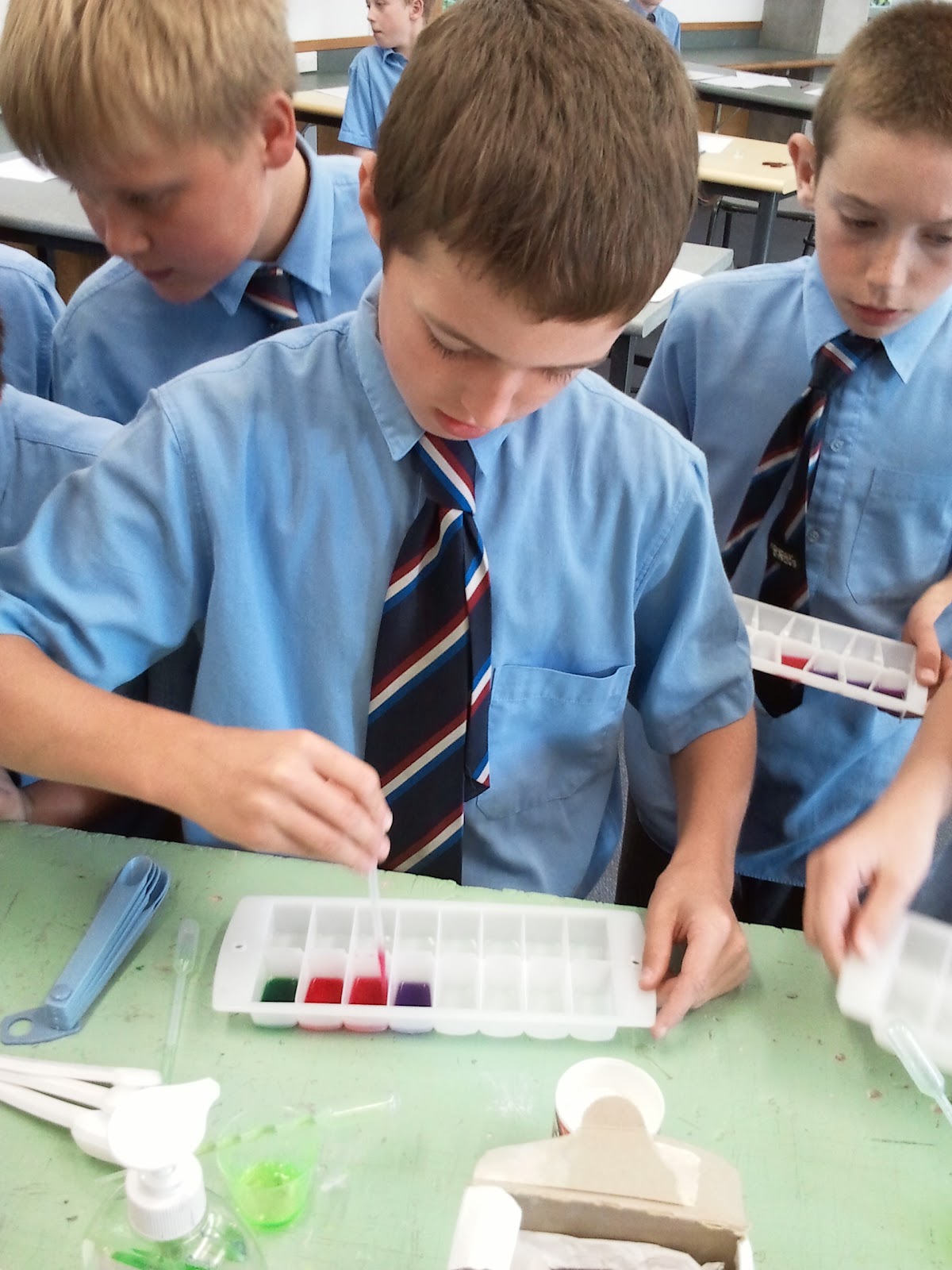
Following on from their visit, we completed some very hands on activities exploring science in our own kitchen.  Using our own home-made indicator from red cabbage, boys found out about acids and bases.  They also got to explore different ways to separate mixtures by filtering, evaporation and using magnets.


It was a great opportunity for both classes to complete some experiments using equipment.  I think many of the boys really thought they were doing 'real' science when they got to use the spirit burners and test tubes!
Of course, we had to end the unit with some taste testing in our kitchen chemistry unit.  Making Sherbet Fizz proved to be a hit, although I think the boys, going by their expressions, found tasting the tartaric acid rather sour!

Year Two's Physical World

Throughout term two, the junior school has been exploring some physical world units.  Year Two completed an investigation into light and colour.  Boys bought along to school their own torches and we had lots of fun making the classroom dark so that we could explore light.  We talked about where light comes from, how it travels and then we did lots of activities with our torches.
 The year 2 class explored a range of materials to see if they were opaque, transparent or translucent.  They were then able to sort their objects into appropriate groups.

By far the most fun was making shadows and exploring how to make them bigger and smaller.  We even went outside and the boys paired up and drew around their own shadows.


Year Two had lots of fun exploring with magnifying glasses, we looked at the shape of different lenses and what happens when we put them close to our eyes, further away.  We talked about how useful magnifiers are and what people might use them for.

Thursday, 14 June 2012

A Term of Fair Testing

Our school Science Week is next week and walking around the school, it is great to see so much science happening in all the classes.


Leading up to next week, boys across all year levels have been learning about fair testing and how to conduct a scientific investigation.  Both Year 4 and Year 5 have conducted a number of fair tests and in the science room they investigated what was the best substance to put on roads to stop them being icy and slippery.  Classes were divided into groups and then each group carefully tested four different substances by sprinkling them onto ice cubes and then observing and recording which ice cube melted the fastest.  From this, they learnt how to identify the different variables, the importance of fair testing and repeat testing, how to write observations, record data and form conclusions based on what their results told them. 

Tuesday, 5 June 2012

The Transit of Venus 2012

Tomorrow is a special, one of a kind sort of day.  Tomorrow is the Transit of Venus.  This is the day when Venus will pass between the sun and Earth.  It was last seen  in June 2004, and before that in December 1882.  This event is so rare, that no-one alive today will see it again.
Historically, the Transit of Venus has been used to help calculate the earth's distance from the Sun.  This rare alignment is how we measured the size of our solar system.  Captain James Cook observed the 1769 Transit on his ill-fated Tahiti voyage.  Many explorers and astronomers have made great voyages to learn more about the planets through the Transit of Venus.

The transit will cross the edge of the Sun at about 10.15am and take 18 minutes to move completely on to the solar disc.  The mid-point will be at 1.30pm and Venus will exit the disc at 4.25pm.

New Zealand's weather forecast is not looking good!  With much rain and cloud forecast, the chance of having a clear view is very slim.  Lets keep our fingers crossed.

NEVER VIEW THE SUN WITH THE NAKED EYE OR WITH ANY OPTICAL DEVICE SUCH AS BINOCULARS OR A TELESCOPE!

Have you ever taken a magnifying glass out into the sun and burnt leaves or paper?  When the focused sunlight comes through the lens, it is refracted and concentrated to a small spot.  In your eye, you have a lens just like that.  If you look at the sun, your eye-lens will concentrate the sun's light and focus it to a very small spot on the back of your retina.  This can cause permanent eye damage or blindness.  There are no pain sensors back there so you won't even know it's happening!!

Even if our view is very brief, it is very important that we do not look directly at the sun.  Special viewing glasses can be purchased from both the Carter Observatory and the Astronomical Society of NZ.  You can also make yourself a simple pinhole projector (the exploratorium has a simple explanation), all you need is some white card and a pair of binoculars.